Professional Summary Policy leader with 16+ years of experience in the Government of Newfoundland and Labrador, specializing in renewable energy policy, post‑secondary education governance, regulatory oversight, and strategic planning. Recognized expert in historical maritime and naval education, international economic relations, and labour market history. Adept at managing teams, developing policy frameworks, preparing Cabinet submissions, and coordinating interdepartmental and national committees. Experienced educator, researcher, and published historian with a strong record of analytical work and public service.
Professional Experience Manager, Renewable Energy Policy Department of Energy and Mines, Government of Newfoundland and Labrador November 2022 – Present - Lead divisional staff and oversee work related to renewable energy policy development and implementation. - Provide strategic direction on renewable energy initiatives and interdepartmental coordination.
Program and Policy Development Specialist Department of Education, Government of Newfoundland and Labrador March 2021 – November 2022 - Delivered management‑level analytical and policy advice on university‑level post‑secondary issues. - Prepared briefing notes, Cabinet submissions, and ministerial correspondence. - Represented the Department on provincial, regional, and national post‑secondary committees.
Program and Policy Development Specialist & Access to Information Coordinator Digital Government and Service NL September 2020 – March 2021 - Oversaw approximately ten agencies, boards, and commissions, including self‑governing regulatory bodies. - Advised on strategic plans and annual reports; collaborated with the Independent Appointments Commission. - Managed Access to Information requests, redactions, and compliance with legislation.
Program and Policy Development Specialist Department of Education, Government of Newfoundland and Labrador June 2009 – August 2020 - Provided policy advice on Memorial University and post‑secondary education issues. - Drafted Cabinet submissions, briefing materials, and ministerial correspondence. - Served on multiple intergovernmental committees.
Director (Acting) & Superintendent of Private Training Department of Education, Government of Newfoundland and Labrador April 2017 – August 2017 - Led the Literacy and Institutional Services Division during a government‑wide reorganization. - Oversaw provincial post‑secondary institutions, infrastructure files, and regulatory responsibilities under five Acts. - Issued provincial post‑secondary instructor certifications.
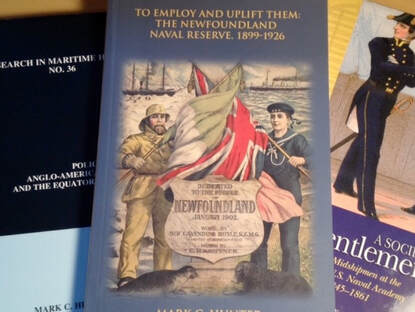
Historian (Contract) Self‑Employed May 2007 – May 2009 - Collaborated with global publishers and editors; approved edits and proofs for multiple historical works, including: A Society of Gentlemen (Naval Institute Press, 2010) To Employ and Uplift Them (ISER Books, 2009) Policing the Seas (IMEHA, 2008)
Per Course Lecturer Memorial University of Newfoundland January 2003 – April 2007 Courses taught included: - History 1010: North Atlantic in the Age of Expansion - History 1012: The World in the 20th Century - History 1014: U.S. Issues (Atlantic Slave Trade; Communism) - History 2110: The North Atlantic since 1820 - History 4111: The North Atlantic in an Age of War and Revolution
Postdoctoral Researcher Institute of Social and Economic Research, Memorial University September 2004 – August 2006 - Developed and executed research plans, budgets, and deliverables. - Conducted archival research in Newfoundland and Labrador, Ottawa, and the United Kingdom. - Analyzed social, economic, and political data; advanced findings to publication.
Researcher Newfoundland and Labrador Statistics Agency February 2004 – July 2004 - Compiled census research briefs and finding aids.
Education PhD, History University of Hull 1999 – 2004 Thesis: The Political Economy of Anglo-American Naval Relations: Pirates, Slavers and the Equatorial Atlantic, 1819–1863.
Master of Arts, History Memorial University of Newfoundland 1997 – 1999 Thesis: “With the Propriety and Decorum which Characterize the Society of Gentlemen”: The United States Naval Academy and its Youth, 1845–1861.
Bachelor of Arts, Honours, History Memorial University of Newfoundland 1992 – 1997
Select Professional Development - Climate Change and Human Rights - Amnesty International (2025) - Net Zero 101: What, Why and How - United Nations University (2024) - Green Industrial Policy - UNITAR (2024) - Renewable Energy Specialization (Non‑Credit Certificate) - University of Colorado Boulder (Coursera), Credential ID Y9CEEPJFE925 (2023)
Other Certifications - Certificate in Proficiency in Amateur Radio — Innovation, Science and Economic Development Canada, Credential ID 19889910666 (1988)
Skills - Renewable Energy Policy - Public Sector Governance - Strategic Planning and Analysis - Cabinet Submissions and Briefing Notes - Post‑Secondary Education Policy - Regulatory Oversight - Access to Information - Research and Data Analysis - Government-University Relations - Archival Research - Project Budgeting and Reporting - Teaching and Curriculum Delivery
Research & Expertise - Historical maritime and naval education and training - Non‑state actors in the Atlantic world - International economic relations - Newfoundland labour market history - Fisher employment strategies in the early 20th century
Community & Interests - Volunteer in the St. John’s arts community - Amateur Radio Operator since 1988 - Interest in experimental and Earth‑observing environmental satellites
Publications A Society of Gentlemen: Midshipmen at the U.S. Naval Academy, 1845-1861 Naval Institute Press · 2010 Extending my peer-reviewed essay in the Journal of Military History (2006), about professionalization in the antebellum US Navy, this book-length study of officer education at the US Naval Academy from 1845 to 1861 reveals that the navy exhibited many elements of a professional organization, through the US Naval Academy, before the Civil War. Annapolis recruited potential officers selectively, instilled in them the ethos of the profession, and weeded out those it deemed unsuitable through examination and discipline. In this way, the US Navy established officers with the specific skills and ethos required to serve the needs of their client, the state.
To Employ and Uplift Them: The Newfoundland Naval Reserve, 1899-1926 Memorial University Books · 2009 This social history of the Royal Naval Reserve in Newfoundland reveals that rural fishers incorporated reserve service into their ‘occupational pluralism,’ working different jobs throughout the year. Consequently, the Royal Navy had to consider colonial economic, political and social conditions when it formulated recruiting, training and retention strategies. When successful, the program transferred income to Newfoundland. But the British terminated the Newfoundland reserve because of financial restraints in Britain and the changing nature of the North Atlantic world after the Great War.
Policing the Seas: Anglo-American Relations and the Equatorial Atlantic, 1819 to 1865 International Maritime Economic History Association / Liverpool University Press · 2008 This study reveals that Washington and London used their maritime and naval policies to further economic goals in the Atlantic while suppressing piracy and the slave trade. When their national interests clashed, they rearranged their naval forces to appease the offended party, and resumed their objectives until tensions again accumulated. Consequently, naval relations acted as a safety valve in wider Anglo-American relations until the outbreak of the Civil War.
“Piraten im Golf von Mexiko im frühen 19. Jahrhundert,” in Hartmut Roder (ed.), Piraten – Abenteuer oder Bedrohung? Edition Temmen · 2002 This book chapter discusses the shape of the market for pirate goods in the Gulf of Mexico during the nineteenth century. The analysis shows that, initially, pirates operated organized and formal trade networks between Cuba and the Yucatan Peninsula. But as British and American naval forces put increasing pressure on pirates in the 1820s, these networks collapsed and pirate activities became sporadic and opportunistic.
“COVID and Creativity,” Word Magazine (October 2020): 24. This essay published by WritersNL in its journal recounted creative activities by Mark Hunter and Ellen Reid during the 2020 COVID-19 pandemic lockdown.
“Patriots and a Menace: American Values and the Pirate Paradox, 1776-1827,” The Journal for Maritime Research 12, no. 1 (December 2010): 1-26. This essay published by the National Maritime Museum, Greenwich, analyzes American society’s interpretations of piracy during various wars from 1776 to 1827 (e.g., the American Revolution, the War of 1812, the Spanish-American and Greek wars of independence). Using American political and literary writing, as well as court records, it reveals how competing views of the American ideology shaped people’s understanding of piracy, other societies and “the Other” during war.
“HMS Calypso: Locating the Newfoundland Royal Naval Reserve Drill Ship, 1900-22,” Great Circle 28, no. 1 (2006): 36-60. This study shows that economic, environmental, and political forces outweighed upper-class concerns over the moral welfare of rural Newfoundland fishermen when the Royal Navy decided where to station the Newfoundland naval reserve’s drill ship. Initially fearing the corrupting influence of a stereotypical port, authorities acquiesced to the political and economic need to place HMS Calypso in St. John’s rather than in remote Placentia where the men would have been isolated from the sexual promiscuity that the elite felt haunted the St. John’s dockside.
“The US Naval Academy and its Summer Cruises: Professionalization in the Antebellum US Navy, 1845 to 1861,” The Journal of Military History 70, no. 4 (October 2006): 963-994. This paper supports the argument that professionalization arose in the US armed forces before the Civil War. At the US Naval Academy, the navy recruited, assessed, and instilled students with a professional ethos. This strategy was particularly evident during summer training cruises as students sailed the North Atlantic and visited major ports.
“The Hero Packs a Punch: Sir Charles Hotham, Liberalism, and West Africa, 1846-50,” Mariner’s Mirror 92, no. 3 (August 2006): 282-299. This paper argues that Sir Charles Hotham represented the forces of liberalism and ‘gentlemanly capitalism’ as Britain sought to implement economic policy and informal empire along the West African coast. Hotham was sensitive to London’s policy objectives and tried to appease rival powers – like France and the United States – while maintaining a check on their economic and strategic advances along the coast.
“Changing the Flag: The Cloak of Newfoundland Registry for American Rum-Running, 1924-1934,” Newfoundland and Labrador Studies 21, no. 1 (Spring 2006): 41-69. During the North Atlantic’s prohibition era, Newfoundland was a safe-haven for rum-runners. The colony had a poorly organized customs force, weak enforcement, and was unable to police the seas far beyond the capital, St. John’s. Thus, as Canada and the United States placed greater pressure on rum-runners, analysis of intelligence reports and data from the Atlantic Canada Shipping Project reveal that suspected Newfoundland-based rum-runners became increasingly Canadian owned. The situation only changed when London took direct control of the island’s political system in the 1930s and reformed the customs service.
“Anglo-American Political and Naval Response to West Indian Piracy,” International Journal of Maritime History 13, no. 1 (June 2001): 63-93. This paper reveals that Americans deployed naval forces to the Gulf of Mexico to police pirates after the Napoleonic wars quicker than Britain because the US lacked international commitments and the threat was close to home. In contrast, London, seeking access to Latin American markets, was wary of taking forceful action against the pirates – many of whom were rebels – until Latin American independence was secured. London feared that quick and forceful action would drag European powers into the region as competitors. The study reveals that wider political and economic concerns shaped naval and diplomatic responses to the crisis.
“Youth, Law, and Discipline at the US Naval Academy, 1845-1861,” The Northern Mariner/Le Marin du nord 10, no. 2 (April 2000): 23-39. The concept of adolescence in the West has evolved to reveal a separate stage of life. This study concludes that middle-class America, during the nineteenth century, shared this opinion and wanted their children educated in a safe environment for a future career. The US Naval Academy was an institution that shared this belief as it professionalized its officer corps. Consequently, adolescents were attracted to the Academy and the facility disciplined its pupils in a manner that accounted for the students’ age and inexperience
This website uses marketing and tracking technologies. Opting out of this will opt you out of all cookies, except for those needed to run the website. Note that some products may not work as well without tracking cookies.